
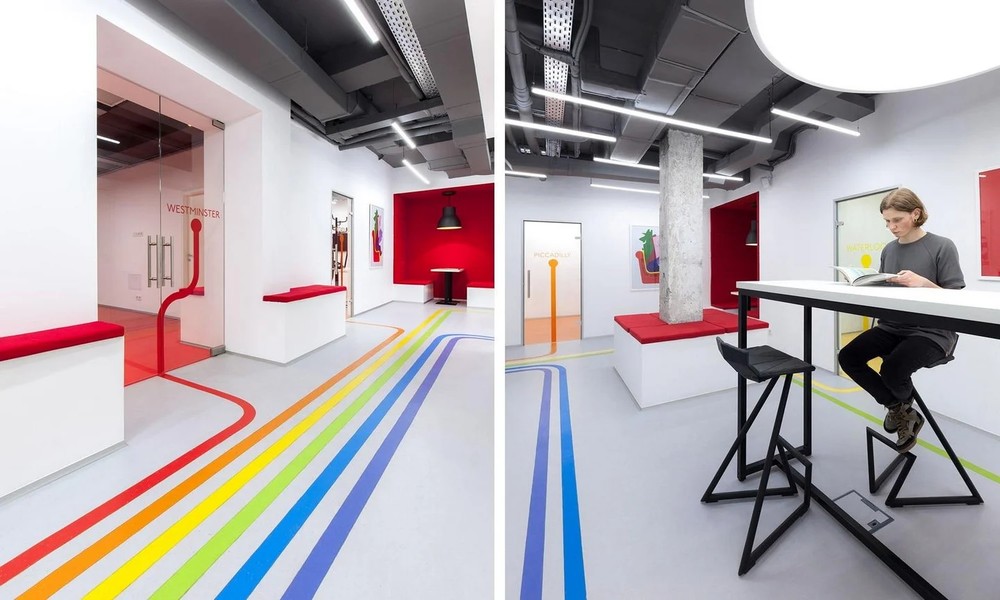

Easy navigation in terminally large spaces is not by chance. It is an outcome of a thorough planning, pictorial understanding and imagination. The role played by design firms in influencing the way the people experience the environments is great. Individual art curation is collaborative with design to create spaces that are user friendly and purposeful.
Understand how wayfinding design connects people to places
Basics of wayfinding and visual guidance
What wayfinding does is to assist one to move around spaces. It employs the aspects of design to make informed decisions. Good wayfinding has a combination of form and function. It sometimes contains original art, design, and spatial indicators.
How design firms approach wayfinding projects
Design firms have structured processes. These procedures provide transparency, integrity and durability. They look beyond signs. They look at the dynamics of movement and association of people with space.
Key responsibilities of design firms in wayfinding:
- Spatial analysis – Design firms examine the movement of people in and out of spaces to locate the elements of guidance where decisions are readily made.
- Visual hierarchy – Designers arrange the information in a way that important directions will be the highlight as the secondary information provided will be supportive.
- Design consistency – Fonts, colors, materials, and symbols are prepared to form a non-disruptive navigation system.
- User-centered thinking – Wayfinding will be designed not according to assumptions but behavior of the user.
Connection between custom art curation and wayfinding
Wayfinding design LA is empowered by custom art curation. Art gives identity and emotional attachment. Art is used to identify the destinations by design firms. This enhances easy navigation.
Applications of custom art to the wayfinding design:
- Visual landmarks – Pieces of art selected serve as a marker that enable users to remember a place visually.
- Material integration – Aside from the tactile guidance, masses move subtly over spaces with the help of textures and finishes.
- Cultural alignment – Custom art implies the mission and values of the space.
- Engagement boost – Art will draw attention and users will be able to navigate.
How to plan effective wayfinding with a design firm
The process of planning starts with teamwork. Design companies collaborate with stakeholders. Having clear objectives assists in decision making on design. This guarantees that functionality and creativity remain in line.
Activities to be undertaken in dealing with design firms:
- Define user needs -Who is going to use the space and how do they circulate in the space?
- Map key routes -Mark the key paths and decision-points at the initial stage.
- Integrate art early -Art curation must not be an after-thought in the planning.
- Test visual cues -Before final installation, designs are studied to make the designs clear.
- Plan maintenance -Materials and location are selected to be long-lasting, and changed.
Benefits of professional wayfinding design
Experience is made better by professional wayfinding. It removes all ambiguity and enhances comfort. Design firms provide experience. They have effective and silent systems.
Benefits of a wayfinding design conducted by experts:
- Improved user confidence -Better guidance can earn the user the sense of being comfortable with the unfamiliar territory.
- Stronger identity – Wayfinding goes hand in hand with brand and design language.
- Efficient movement – People come to the destinations faster and with a smaller number of questions.
- Lasting impact – Properly developed systems are efficient in the long run.
Conclusion
The design of wayfinding is efficient and imaginative. Design firms unite order, creativity, and vision. Custom art collection enhances navigation. Careful architecture streamlines the spaces to make them more comprehendible and pleasant.
