
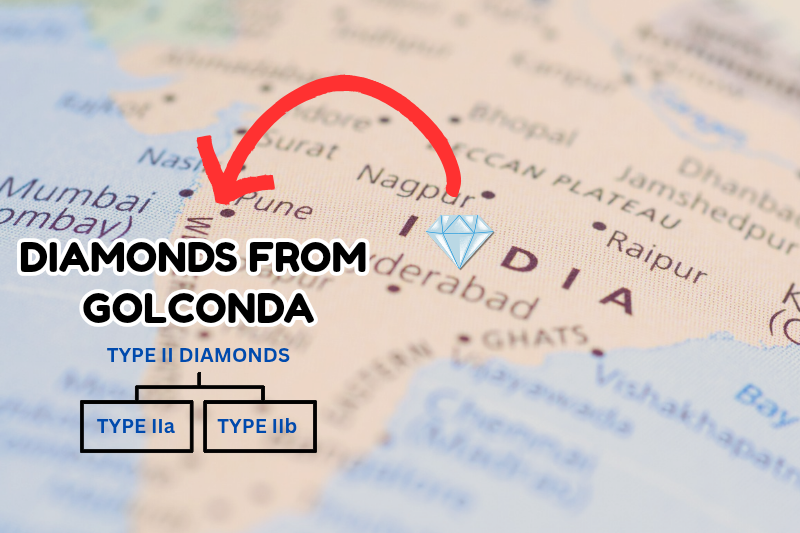

The Golconda mines of India have long been celebrated for producing some of the world’s most exceptional diamonds. Among these, Type II diamonds are particularly noteworthy. In gemological terms, diamonds are classified into types based on the presence and arrangement of nitrogen and boron impurities. Type II diamonds are characterized by an absence or very low concentration of nitrogen impurities, which allows them to exhibit exceptional optical clarity and purity. This contributes to the brilliant, colorless appearance of many Golconda diamonds, making them highly prized by collectors and connoisseurs.
TYPE IIa GOLCONDA DIAMONDS
Type IIa diamonds are almost entirely free of nitrogen atoms, making them chemically pure. This purity often manifests in exceptional optical transparency and remarkable colorlessness. Type IIa diamonds are relatively rare in nature, and Golconda has been a historic source of many of the world’s finest Type IIa diamonds. These diamonds are prized not only for their clarity but also for their historical significance, as many were owned by royalty or noted collectors.
Some Type IIa Golconda Diamonds:
The Koh-i-Noor Diamond – Originally weighing around 793 carats in its rough form, the Koh-i-Noor is one of the most famous Type IIa diamonds from Golconda. After multiple recuttings over centuries, its current weight is 105.6 carats.
The Great Mogul Diamond – Weighing approximately 787 carats in its rough state, this Type IIa diamond is noted for its extraordinary size and brilliance.
The Daria-i-Noor Diamond – Weighing about 182 carats, this pale pink diamond is a rare example of a Golconda Type IIa diamond with slight coloration, yet it retains the exceptional clarity characteristic of Type IIa stones.
TYPE IIb GOLCONDA DIAMONDS
Type IIb diamonds are even rarer than Type IIa diamonds and contain trace amounts of boron, which gives them a distinctive blue or bluish-gray hue. These diamonds are not only visually stunning but also semiconductive, which is unusual for diamonds. Blue Golconda diamonds have been highly coveted throughout history due to their extraordinary color and rarity.
Some Type IIb Golconda Diamonds:
The Golconda Blue Diamond – Weighing a little over 23 carats, this vivid blue diamond is a rare Type IIb gem that exemplifies the extraordinary quality of Golconda’s color diamonds. The Golconda Blue Diamond was slated to headline Christie’s Magnificent Jewels auction in Geneva on 14 May 2025. In a shocking turn of events, the owner of the high value Golconda diamond chose to withdraw the diamond from the auction.
The Seraphim Blue Diamond – A notable Type IIb diamond from Golconda, weighing around 6 to 7 carats, it showcases the rich, deep blue color characteristic of boron-containing diamonds. The Seraphim Blue Diamond was worn by Asaf Jah I, the first Nizam of Hyderabad (around 1724) in an opulent turban ornament. The common narrative in trade circles and a few reports is that, the second Nizam (Asaf Jah II) gave the pear shape diamond, to the French. The diamond was apparently used to pay for military support from the French military.
The Hope Diamond – The Hope Diamond is one of the most legendary gems in history, famed for its deep blue color, striking brilliance, and fascinating journey through royal hands, collectors, and museums. Weighing 45.52 carats, this extraordinary gem is a rare Type IIb blue diamond, a classification shared by only a tiny fraction of the world’s diamonds. Its mesmerizing blue hue is caused by trace amounts of boron within its crystal structure. Originating from the historic Golconda region of India, the Hope Diamond is now housed in the Smithsonian Institution, where it continues to draw millions of visitors with its mystery and beauty.
In conclusion, Golconda mines have historically produced some of the world’s most exquisite diamonds, with Type II stones representing the pinnacle of clarity, purity, and rarity. Type IIa diamonds from Golconda are renowned for their chemical purity and brilliance, while Type IIb diamonds are distinguished by their rare blue color and semiconductive properties. Together, these diamonds exemplify the unmatched allure and enduring legacy of Golconda’s gemological heritage.
