
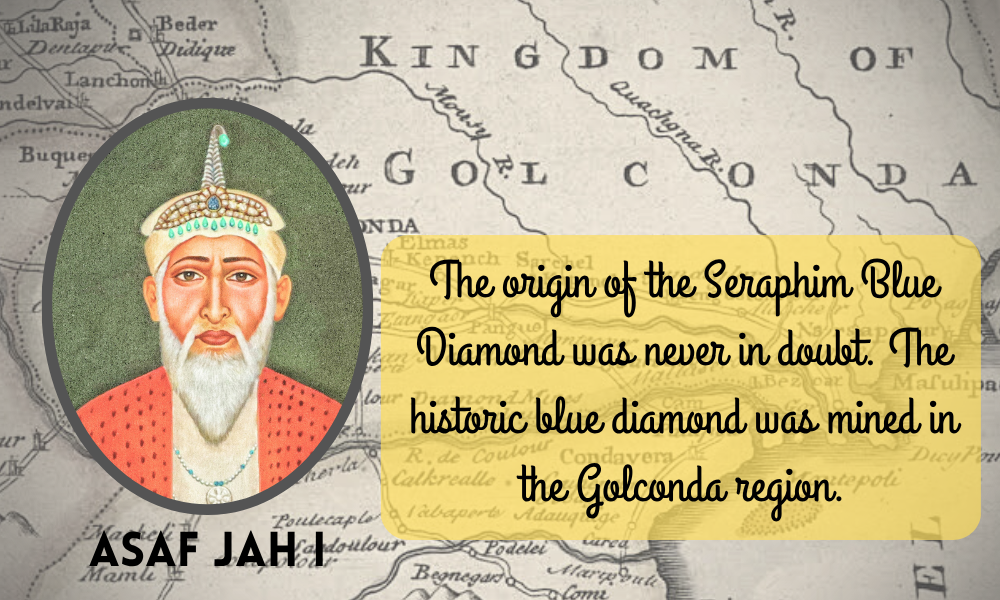

Rumors suggesting that the famed Seraphim Blue Diamond originated from the South African diamond mines are not based on historical fact. The diamond’s provenance dates back to around 1724, a period that predates the discovery of diamonds in South Africa by well over a century. Around that time, Asaf Jah I, the first Nizam of Hyderabad, wore this magnificent pear-shaped, old-mine cut blue diamond in a treasured turban ornament. This establishes a firm historical context for the gem long before South African diamond mining began.
GOLCONDA DIAMOND MINES
The Golconda diamond mines, located in the present-day Indian states of Telangana and Andhra Pradesh, were the world’s primary source of diamonds for many centuries. Known for producing some of the most exceptional gems in history—including the Hope Diamond, the Koh-i-Noor, and the Regent Diamond—Golconda became synonymous with purity, brilliance, and rarity. The Seraphim Blue Diamond, too, has been verified to have originated from these legendary mines. The old-mine cut and its distinct blue hue further reinforce its Golconda heritage.
SOUTH AFRICA DIAMOND MINES
By contrast, diamond mining in South Africa began in 1867, following the discovery of diamonds along the Orange River and later at Kimberley. This discovery triggered the South African diamond rush, transforming the global diamond industry. While South African mines, particularly the Premier Mine, have occasionally yielded rare blue diamonds—including the famous Cullinan Blue—this occurred much later than the period associated with the Seraphim Blue Diamond’s early history.
At the time when Asaf Jah I adorned his turban with the blue diamond, the Golconda mines had already entered their declining years. By the mid-18th century, their output had diminished, but the diamonds already extracted continued to circulate among royalty and nobility in India, Persia, and Europe. It was a period when Golconda diamonds were revered not just for their size and clarity but also for their unique provenance, which added a layer of cultural and historical prestige.
BLUE DIAMOND EXCLUSIVITY
Blue diamonds have always been exceptionally rare and valuable, owing to the presence of trace amounts of boron that give them their distinctive color. In modern gem markets, any blue diamond attracts significant interest. However, when a blue diamond can be proven to originate from the Golconda mines, its value escalates dramatically. This is because Golconda diamonds are typically Type IIa—almost completely devoid of nitrogen impurities—resulting in exceptional transparency and brilliance. A blue Golconda diamond is thus an extraordinary rarity.
The persistent rumors linking the Seraphim Blue Diamond to South Africa likely stem from the later prominence of South African mines in the global diamond trade. By the late 19th and early 20th centuries, South Africa had become the world’s primary diamond producer, and many famed stones were traced to its deposits. Nevertheless, the Seraphim Blue Diamond’s history, physical characteristics, and documented provenance point unmistakably toward Golconda.
NOTES
In conclusion, the Seraphim Blue Diamond’s origin is not shrouded in mystery but rather supported by historical evidence. Its journey began in the Golconda mines, centuries before South Africa entered the diamond story in 1867. The gem’s association with the Nizams of Hyderabad and its Golconda pedigree elevate it to an elite category of historic blue diamonds—rare, storied, and enduringly captivating.
